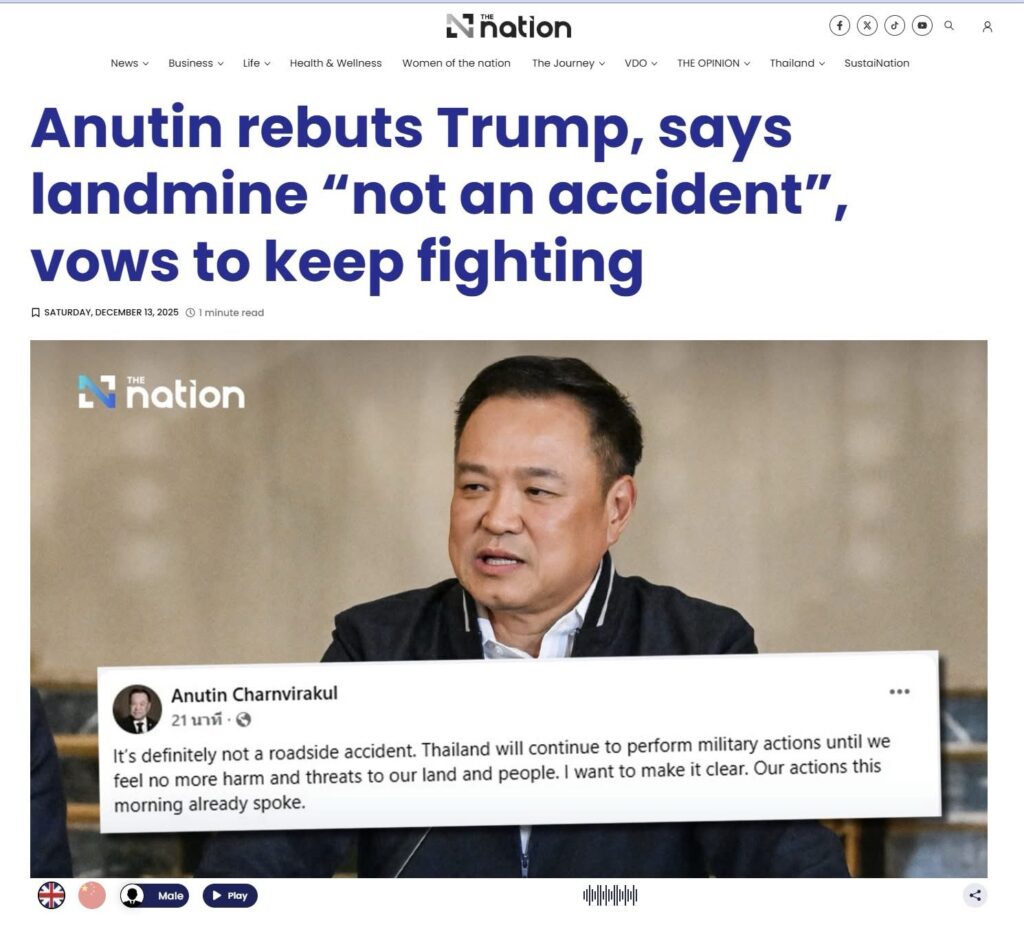
By declaring the landmine “not an accident” and vowing to continue military action until Thailand alone feels “no more threat,” Bangkok is replacing evidence with assertion and process with perception.
That matters.
In conflicts, intent is not established by insistence, and ceasefires are not invalidated by disagreement. They are tested by independent verification. When one side rejects verification while expanding its discretion to use force, the issue is no longer who is right it is who is accountable.
If the landmine was deliberate, that claim requires:
- forensic examination
- independent assessment
- shared evidence
- third-party confirmation
Without these, certainty becomes narrative, not fact.
Equally important is what the statement omits. There is no reference to:
- ASEAN monitoring
- neutral observers
- timelines
- humanitarian safeguards
- civilian protection mechanisms
An open-ended pledge to “keep fighting” based on subjective threat perception leaves no procedural off-ramp. It also places civilians on both sides outside any enforceable protection framework.
Cambodia has called for verification, including satellite evidence and third-party review. That is not weakness. It is how responsibility is clarified and escalation constrained.
Peace is not built by insisting others accept one side’s certainty. It is built by allowing facts to be tested especially when lives are already being lost.
If Thailand is confident in its claims, independent verification does not weaken its position.
It strengthens it.
And if verification is refused, the international community should ask why.
Midnight pages