This is no longer a frozen crisis. It is a moving one.
At this point, the question is no longer whether escalation might occur. It is whether anyone still has the institutional capacity to stop it.
The caretaker constraint
Two days ago, I examined Prime Minister Anutin Charnvirakul’s position as a way of understanding how Thailand’s internal political system shapes its external behaviour in moments of crisis. That analysis was not abstract. It is now visible on the ground.
Thailand entered a caretaker phase following the dissolution of parliament on December 11. In such periods, political initiative narrows rather than expands. Elected leaders avoid new commitments. Authority shifts toward institutions insulated from electoral reset, most notably the armed forces. Security posture becomes default rather than debated policy.
This matters because caretaker governments do not de-escalate conflicts. They manage them procedurally, while momentum accumulates elsewhere.
Public statements since December 12 reveal the contradiction clearly. International interlocutors have spoken of ceasefire and a return to agreed frameworks. Thailand’s leadership, by contrast, has signalled that military operations will continue until all perceived threats are removed. These positions cannot coexist for long without one overriding the other.
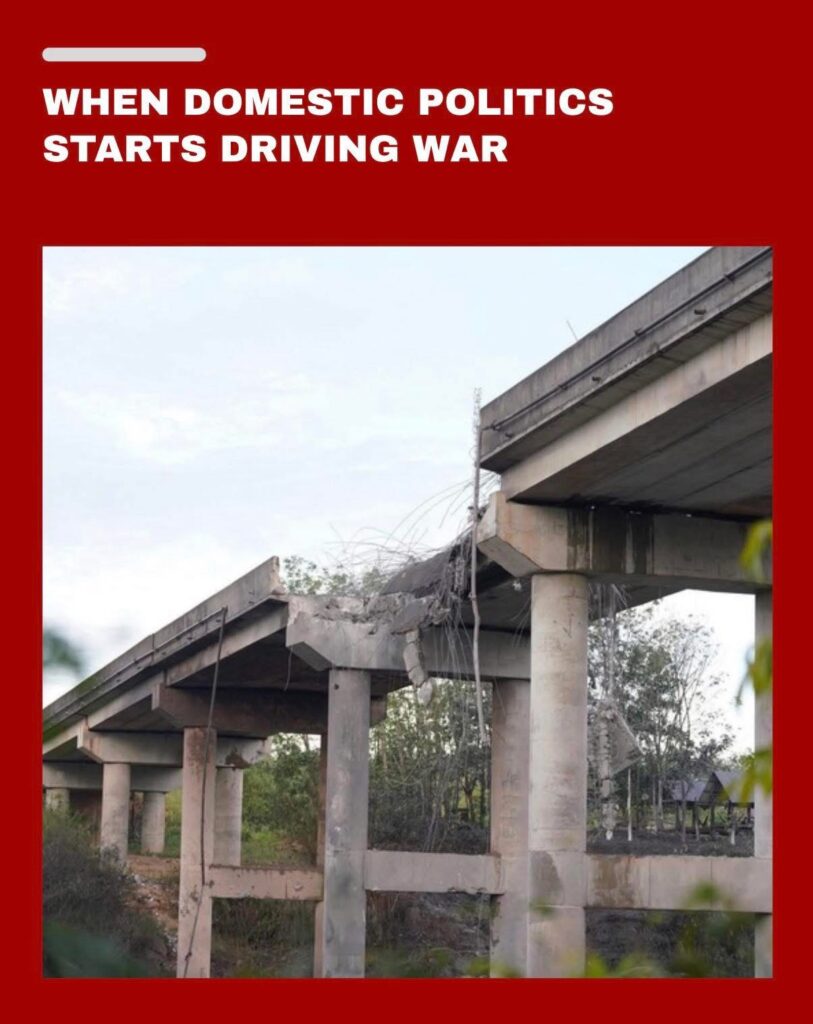
The result is visible. Bridges do not collapse by accident. Artillery does not expand its footprint by misunderstanding. These are decisions taken within a structure where rhetoric is locked upward and restraint is no longer politically rewarded.
This is where concern hardens.
The bilateral trap
Thailand’s right to defend itself is not disputed. What is disputed is whether Thailand’s political system is still capable of narrowing objectives once force is engaged.
Domestic constraints that once balanced escalation and restraint have weakened. Parliament is dissolved. Electoral accountability is paused. The armed forces gain autonomy. Border-province economies suffer, but slowly. International costs accumulate later.
In this environment, escalation does not require intent. It requires absence of brakes.
Cambodia has called for independent verification, including the use of satellite imagery by third parties. That proposal is not about narrative advantage. It is about restoring a shared factual baseline. Both sides now claim self-defence. Without an agreed mechanism for verification, each strike becomes justification for the next.
This is the classic bilateral trap: each move framed as defensive by one side and aggressive by the other.
Why timing matters
The latest strikes occurred hours after publicised ceasefire calls and mediation efforts. That sequence matters. It signals not defiance of diplomacy, but the inability of domestic systems to absorb it quickly enough.
Caretaker phases compress decision-making into security institutions precisely when diplomacy requires political flexibility. What looks externally like deliberate escalation can internally be procedural inertia.
This is not strategy. It is drift.
And drift is how conflicts become wars that nobody planned and nobody can easily end.
Regional precedent
The Preah Vihear clashes between 2008 and 2011 began as limited confrontations, escalated into heavy artillery exchanges, displaced civilians on both sides, and ultimately required international adjudication to restore a fragile calm. The lesson was clear: unresolved border disputes harden quickly once escalation outruns diplomacy.
ASEAN’s preference for restraint and dialogue was shaped by those experiences. As of this writing, ASEAN has not issued a collective response. Silence, however, does not stop momentum. Other governments in the region are watching closely. Precedents set in moments like this rarely remain local.
A narrow window
This is not an argument for passivity in the face of threat. It is a reminder that how a state defines and limits its response can be as consequential as the response itself.
The most dangerous moment in any conflict is not the first shot. It is when institutions designed to slow escalation fall silent, and force begins moving faster than diplomacy. Thailand’s caretaker transition has accelerated that timeline.
What happens in the next forty-eight hours will determine whether this remains containable.