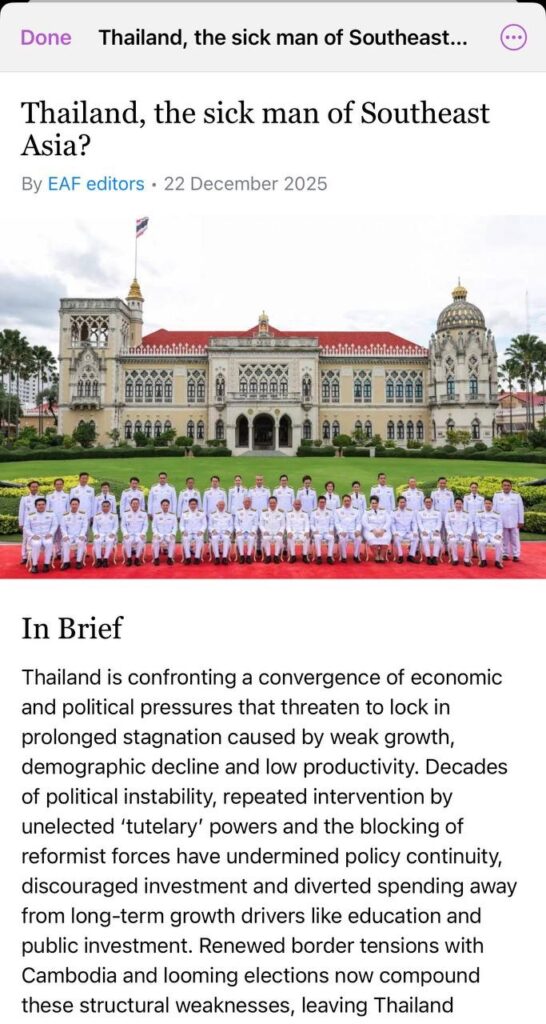
International observers are starting to read Thailand through a different lens not because of one incident, and not because of Cambodia, but because of a pattern that has been building for years.
What they see is not crisis.
They see structural fatigue.
Thailand’s economy is not collapsing, but it is stuck: growth hovering around 2%, productivity lagging, demographics tightening, and an education system no longer aligned with future competitiveness. On its own, that is manageable. What makes it dangerous is what sits underneath.
The deeper issue observers point to is political legitimacy.
Not party competition. Not election drama.
But the unresolved question of whether the ballot box is accepted by all elite factions as the final source of authority.
For more than two decades, Thailand has oscillated between elected governments and unelected “guardians”: the barracks, the bench, and the palace. Each intervention interrupts policy continuity, discourages long-term investment, and shifts public spending toward short-term political management rather than long-term growth.
This is why reform keeps stalling even when it wins votes.
One reformist force, the People’s Party (and its earlier incarnations), continues to attract strong electoral support. Yet it has repeatedly been blocked from governing. From an external perspective, this creates a paradox: popular mandates without governing power.
That paradox is now intersecting with regional tension.
Renewed border conflict with Cambodia is not being read internationally as the root problem. Instead, it is seen as an accelerant, a factor that strengthens unelected institutions, boosts military prominence, and further sidelines civilian authority just as elections approach.
This matters because investors, diplomats, and regional partners do not ask who is louder in a moment of tension. They ask different questions:
• Will elected governments be allowed to govern?
• Can policy survive an election cycle?
• Do institutions restrain power, or override it?
Right now, Thailand is increasingly read as a country where stability is enforced, not settled and where control exists without the growth performance that once justified it.
That is why external pressure is quietly increasing. Not out of hostility, but out of risk management. When a country becomes unpredictable in its political foundations, partners seek to contain volatility rather than deepen reliance.
None of this is moral judgment.
It is institutional reading.
And it explains something important: why Thailand’s regional standing feels thinner than its history suggests, and why every new shock economic, electoral, or security-related now carries heavier consequences than before.
This is not about winning a narrative.
It is about whether a system can still renew itself.
That is the question many outside Thailand are now quietly asking.
Midnight