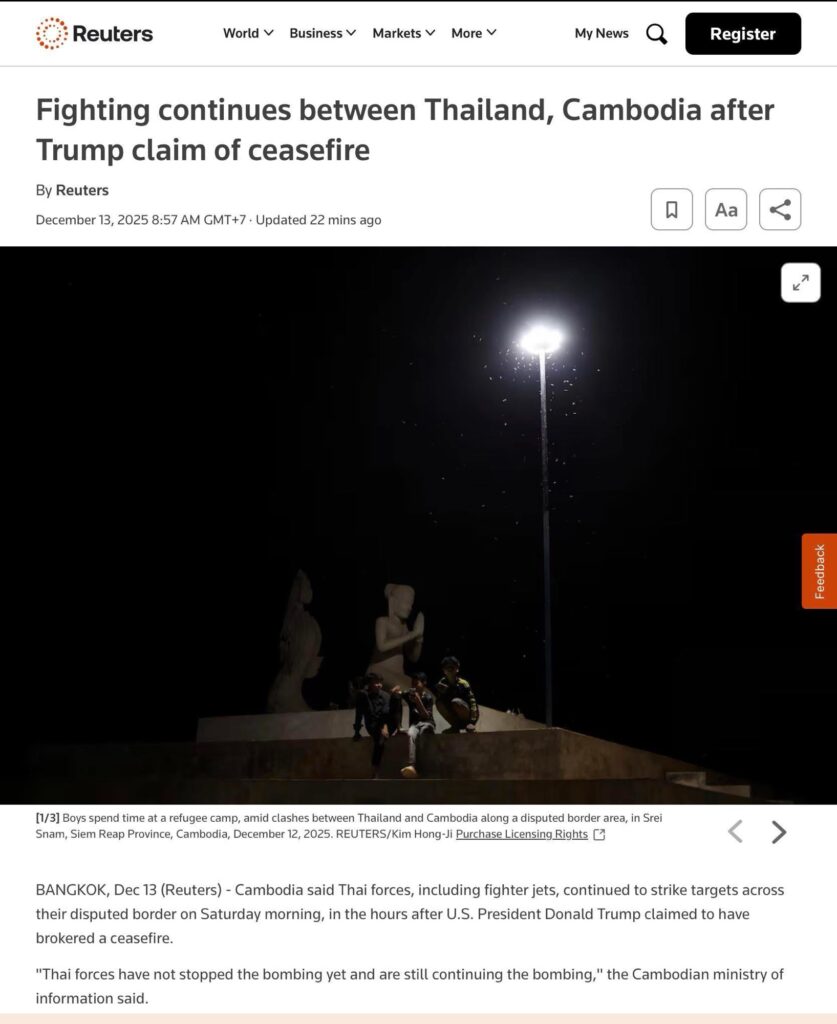
What Reuters is really building in this piece
- The lead is a credibility test, not a battlefield update
The first sentence is not “fighting escalates.” It is: • fighting continues after Trump claimed ceasefire
That construction turns the entire article into an evidence-versus-claim story. The event isn’t “the call.” The event is that the call failed to change reality.
- They anchor “after the call” as the key timeline marker
“in the hours after” is the most important phrase.
That’s Reuters creating a future-citable line: • before call / after call
• claim / outcome
That’s how institutional memory is built.
- They give Cambodia one clean, quotable sentence
They quote the Ministry of Information: “have not stopped the bombing yet…”
That’s not just emotion. It’s a simple falsifiable claim tied to timing.
Reuters is selecting lines that can be tested later.
- They immediately balance with Thailand but notice the type of balance
Thailand “countered with accusations” about: • “repeated violations”
• civilians targeted
• landmines
Reuters does not validate. It labels this as accusations.
That word matters: it keeps the claims in the “asserted” category.
- Trump is treated as a claim-maker, not an enforcer
“Trump said… after calls…” then Reuters immediately shows: • neither leader referenced an agreement
• Anutin said there was no ceasefire
• foreign ministry points back to his statement
This is Reuters documenting a triangular contradiction:
Trump: ceasefire exists
Anutin: no ceasefire
Cambodia: strikes continued
They don’t resolve it. They archive it.
The most damaging line for Thailand in the record
“But neither leader referenced an agreement… and Anutin said there was no ceasefire.”
That single sentence downgrades the entire “Trump brokered it” claim into unsecured intent rather than an implemented agreement.
And because Reuters wrote it, it becomes the line others will reuse.
What Hun Manet’s Facebook paragraph is doing (and why Reuters included it)
Reuters quotes Manet emphasizing:
• peaceful resolution “in line with” Kuala Lumpur October agreement
• asking US/Malaysia to use intelligence to “verify which side fired first”
Two signals here:
• Cambodia is tying itself to an existing process framework (Kuala Lumpur)
• Cambodia is asking for third-party verification rather than demanding belief
That is smart record-making and Reuters includes it because it’s procedurally legible.
Reuters’ “memory stitching” in the back half
Then they do classic Reuters: they stitch the current moment into a longer timeline that explains why this is messy:
• heavy fighting since Monday
• July clash
• Trump halted July with calls
• October expansion in Malaysia
• agreement to withdraw / release POWs
• Thailand suspended last month after landmine incident
• Cambodia denies
This is not filler. It creates a single institutional arc:
attempted truce → expanded process → suspension → relapse → new claim → contradiction
That arc is what diplomats and analysts remember.
What you should take from this (mechanism-level)
This Reuters piece is not “pro-Thai” or “pro-Cambodia.”
It is pro-record.
And the record it is building right now is:
• A ceasefire was claimed by Trump
• But it was not affirmed by both leaders
• And fighting continued after the claim
• Therefore the “ceasefire” is not an implemented fact, it’s disputed intent
That is not “world tilting to Thailand.”
That is the world being handed a documented credibility gap.
Midnight
Source : https://www.reuters.com/world/asia-pacific/fighting-continues-between-thailand-cambodia-after-trump-claim-ceasefire-2025-12-13/