Cambodia’s Entry into Trump’s Board of Peace Signals Diplomatic Positioning but Raises Questions of Role, Risk and Identity
Cambodia said it had joined U.S. President Donald Trump’s Board of Peace as a founding member, according to government statements and posts by the organisation’s official social media account. The Board, unveiled at the World Economic Forum in Davos and chaired by Trump, presents itself as a new international body supporting peace building, governance transition and reconstruction in Gaza, with ambitions to take on future conflict mediation roles.
The White House has described the Board as an official international organisation established under Trump’s “Comprehensive Plan to End the Gaza Conflict,” with a charter, founding members and an executive layer focused on postwar governance and rebuilding. Public listings by the Board show more than two dozen participating countries from the Middle East, Asia and Eastern Europe, including Cambodia.
The initiative has also drawn criticism from civil society groups and political figures in several countries who argue that it lacks democratic mandate, concentrates authority in the hands of its chairman and risks bypassing established United Nations mechanisms. Some critics say the Board blurs peacebuilding with large scale development and investment agendas and was designed without the participation of Palestinian representatives, raising questions about legitimacy under international norms.
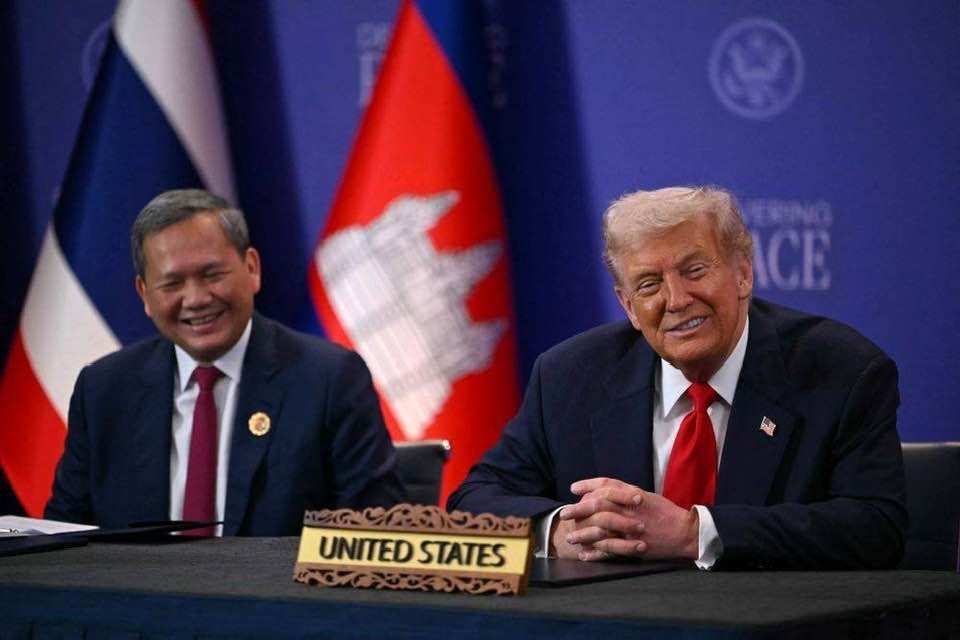
For Cambodia, the decision offers immediate diplomatic visibility but limited clarity on substance. Prime Minister Hun Manet has stressed that Cambodia’s founding membership involves no financial contribution and framed participation as consistent with Cambodia’s long standing commitment to peacekeeping and international cooperation. Cambodia has built much of its foreign policy identity around neutrality, UN peacekeeping and post conflict reconciliation.
The timing of the announcement, which followed a meeting between Hun Manet and the head of U.S. Indo Pacific Command, suggests the move also serves a strategic signaling function. Cambodia has in recent years been widely perceived as closely aligned with China. Joining a U.S. initiated peace framework allows Phnom Penh to project engagement with Washington without altering its core security or economic policies.
Yet the reputational dimension of the decision is more complex. Internationally, the Board of Peace is closely associated with Trump personally and with U.S. political debates over Gaza, reconstruction and future mediation frameworks. Several major powers and European governments have declined or delayed participation, while regional civil society organisations in Southeast Asia have criticised the initiative as illegitimate or legally problematic. This means Cambodia’s membership links it not only to a peace narrative but also to a contested geopolitical project.
The practical obligations of Cambodia’s participation remain unclear. Neither Cambodian officials nor the Board have publicly detailed what “founding member” status entails beyond symbolic inclusion. It is not known whether Cambodia has signed a formal charter, who represents the country within the organisation, or whether participation involves voting rights, policy endorsements or long term commitments. For now, the costs appear largely political rather than financial.
Beyond symbolism, Cambodia now faces a deeper challenge of role definition. Without a clear statement of its responsibilities and limits, Phnom Penh risks having its position shaped by the future actions of a politically contested institution rather than by its own foreign policy principles. Silence may be interpreted internationally as consent to policies Cambodia does not design or control.
The decision also raises questions of consistency. Cambodia has historically supported Palestinian self determination and UN based multilateralism. Participation in a body criticised for excluding Palestinian representation and operating outside established UN frameworks creates a potential gap between Cambodia’s past positions and its present affiliations. This gap may matter in relations with Muslim majority states, Global South partners and human rights forums.
Regional implications are also unresolved. Cambodia joined the Board as an individual state rather than through ASEAN consultation, which may complicate its claim to ASEAN centrality and consensus driven diplomacy. As the Board signals ambitions beyond Gaza, Cambodia could face pressure to take positions on conflicts far removed from its traditional neutral posture.
Another long term risk is durability. The Board is closely tied to Trump personally and to his administration’s political agenda. If the initiative weakens, changes direction or becomes more controversial, Cambodia will remain publicly recorded as a founding member of a Trump led project. Symbolic affiliation may outlast the institution itself.
The decision reflects a familiar pattern in small and middle state diplomacy. Cambodia gains recognition, prestige and a signal of engagement with Washington at low immediate cost. At the same time, it assumes reputational exposure to an initiative whose legitimacy, governance and future scope remain uncertain. The asymmetry is clear. Cambodia lends symbolic legitimacy more than it gains influence.
The broader question is how Cambodia manages this association. If Phnom Penh defines its participation narrowly, anchors it to United Nations principles and maintains distance from controversial policy positions, the move can be framed as an extension of its peacekeeping identity. If the Board evolves into a parallel structure competing with UN led diplomacy or becomes further politicised, Cambodia may find itself lending legitimacy to decisions it does not shape.
Cambodia’s entry into the Board of Peace does not make it a peace broker, nor does it commit it to operational responsibility in Gaza. What it does do is place the country inside a new and uncertain diplomatic experiment at a time when global institutions are increasingly shaped by personality and politics.
For Phnom Penh, the challenge now is not whether it has joined, but how it defines the meaning of that membership before others define it for them.
From: Midnight