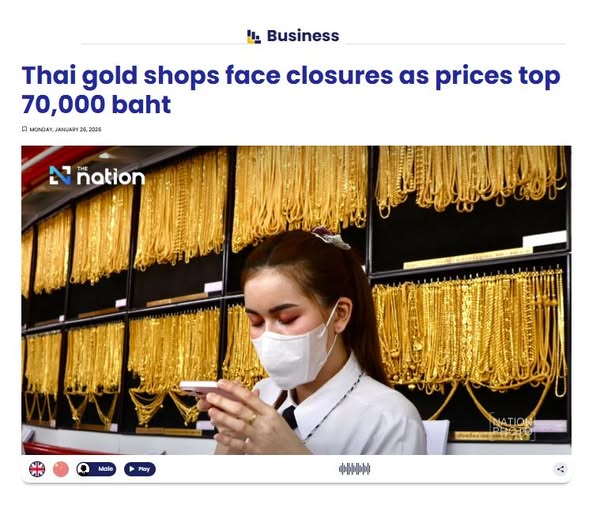
It warns that “gold shops face closures,” but then admits the closures are not caused by losses. They are caused by owners choosing to cash out while prices are high and younger generations refusing to continue the business. That is not collapse. That is exit. The headline and the facts do not match.
Next, the article shifts responsibility away from Thailand’s real economic pressures such as rising costs and shrinking household buying power and replaces them with geopolitics and personality politics. Instead of asking why ordinary people can no longer afford gold, it talks about Iran, the United States, and even suggests one foreign leader is fueling prices without presenting evidence. This is opinion dressed up as market analysis.
The piece also floods readers with spectacular numbers like $5,000 an ounce and 75,000 baht, but provides no data on how many shops will close, which types of shops, or what this means for families who once relied on gold as savings and pawn collateral. Sensation replaces explanation.
Most importantly, the article avoids the uncomfortable question. What happens when gold stops being a household safety net and becomes only a playground for speculators?
By framing the story as global drama and price excitement, the article hides a local reality. Small family gold shops are being squeezed out, and ordinary people are being priced out. The fear is in the headline. The truth is buried in one sentence.
This is not reporting a crisis. It is manufacturing one while missing the real social change underneath.
Midnight