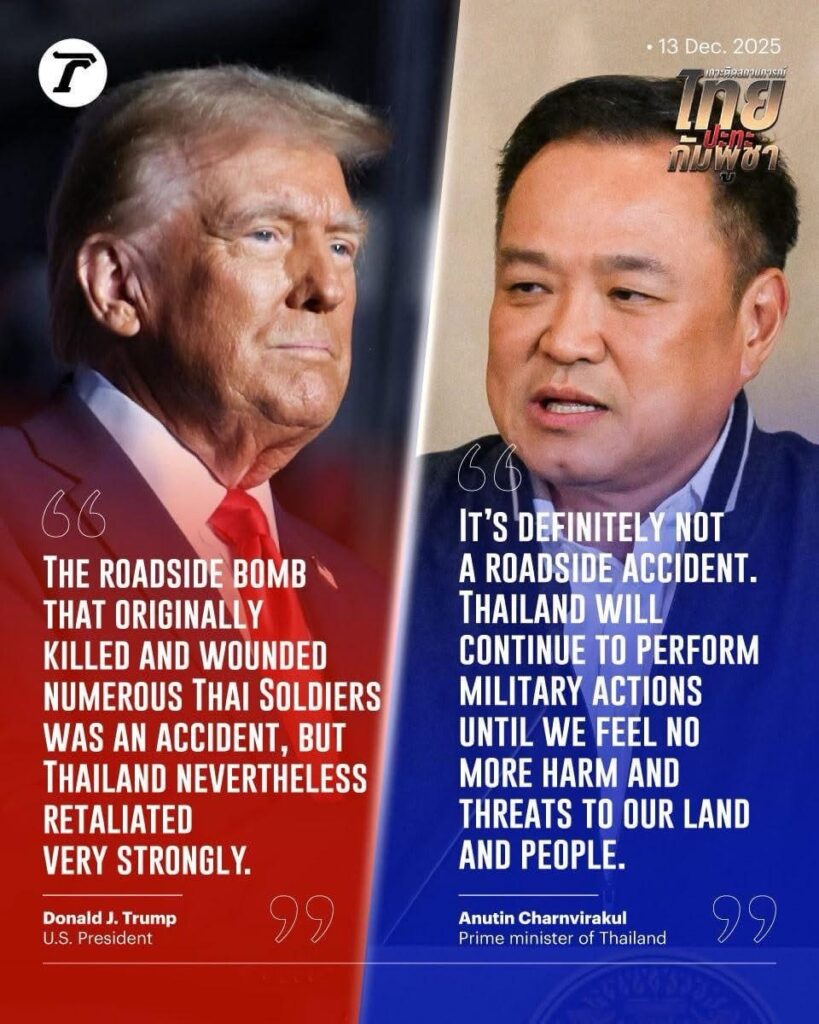
This is why recent statements surrounding the Cambodia–Thailand conflict matter beyond their immediate political context. They reveal a structural shift in how the situation is being managed. Public language now moves faster than observable change. Political transitions are declared irrelevant to operations. Threat is defined subjectively. Incidents are classified by assertion. Humanitarian language is invoked without accompanying procedure. These are not isolated rhetorical choices. Taken together, they form a posture designed less to resolve the conflict than to manage how this period will be archived. The risk, therefore, is not escalation alone, but normalization without closure.
Once a ceasefire is said to exist while actions continue, the central question is no longer whether leaders spoke, but what followed. International assessment does not hinge on statements. It hinges on conduct on the ground, measured over time against standards that can be independently verified. This is where chronology becomes decisive. What happens before and after public claims is not a secondary detail. It becomes the record itself. Over time, patterns of statement versus conduct speak more clearly than any single explanation ever could.
As a result, the conflict has shifted from persuasion to inscription. Public statements are no longer primarily aimed at the other party. They are aimed at external observers, regional institutions, media archives, and future reviewers. Language is being chosen not for immediate effect, but for durability. This is record warfare, where what matters is not convincing today, but surviving scrutiny tomorrow.
Within this context, certain phrases take on disproportionate importance. One of the most consequential is the assertion that military action will continue “until we feel no more threat.” This formulation removes timelines, replaces objective criteria with sovereign perception, and pre-authorizes continuation. The issue here is not sovereignty itself, but the standard being applied. If threat is defined by feeling rather than evidence, there is no neutral endpoint, no external clock, and no mechanism for confirmation. De-escalation becomes discretionary rather than demonstrable. International norms exist precisely to prevent this outcome. They rely on conduct, proportionality, and verification, not internal perception.
The same logic applies to the rush to classify incidents as “accident” or “attack.” This is not a semantic dispute. These labels carry legal consequences. They shape justification, escalation thresholds, and future accountability. For that reason, classification should never be settled by declaration. It belongs to investigation, evidence, and due process. When labels are asserted prematurely, they do not clarify reality. They attempt to pre-empt scrutiny. The correct institutional response is therefore neither acceptance nor rebuttal of such labels, but insistence on independent determination, which preserves credibility and keeps the evidentiary standard external.
Humanitarian concerns, including landmines and civilian risk, must be understood within this same framework. These are real and serious dangers. But humanitarian language only protects civilians when it is paired with procedure. Safety is achieved through transparent mapping, verified clearance, defined timelines, access for observers, and reporting mechanisms. Without these, humanitarian framing risks becoming an open-ended rationale rather than a pathway to protection. There is an additional danger when humanitarian issues are framed without temporal separation. Past, present, and future collapse into a single moral timeline. Responsibility becomes timeless, justification becomes permanent, and resolution is deferred. The antidote is not denial, but process.
Alongside these shifts, a quieter structural change is also taking place. One side defines threat subjectively, while the other is asked to prove compliance objectively. This creates asymmetric burdens. At the same time, caretaker political status is declared irrelevant to authority while benefiting from reduced accountability. Full operational freedom is combined with blurred civilian oversight. This paradox is rarely named explicitly, but it is visible to institutional observers. The appropriate response is not confrontation, but insistence on verification, accountability, and process, which expose the imbalance without escalating rhetoric.
All of this feeds into the most underestimated risk in prolonged conflicts: fatigue. Open-ended language, legal insulation, and repetitive narratives can slowly downgrade international attention from conflict to managed dispute. When that happens, urgency dissipates, accountability thins, and the record hardens by default. This is why restraint in messaging matters as much as clarity. Volume creates exposure. Discipline builds credibility. Silence, when facts are still forming, is not absence. It is asymmetric control.
Against this backdrop, the international standard remains unchanged and must be repeated without variation: facts over claims, conduct over statements, verification over perception, process over rhetoric. This standard applies equally, but it does not require false symmetry. Where actions are verifiable, they should be shown. Where verification is absent, restraint and transparency become the measure of credibility. De-escalation, when it comes, will not be credited to words. It will be credited to verification, observation, and demonstrable restraint. That is how records are built, how accountability is preserved, and how regional stability is restored.
A ceasefire, then, is not a post. It is a sequence of actions that can be seen, measured, and confirmed. History will not remember who spoke first. It will remember who allowed verification.
Midnight