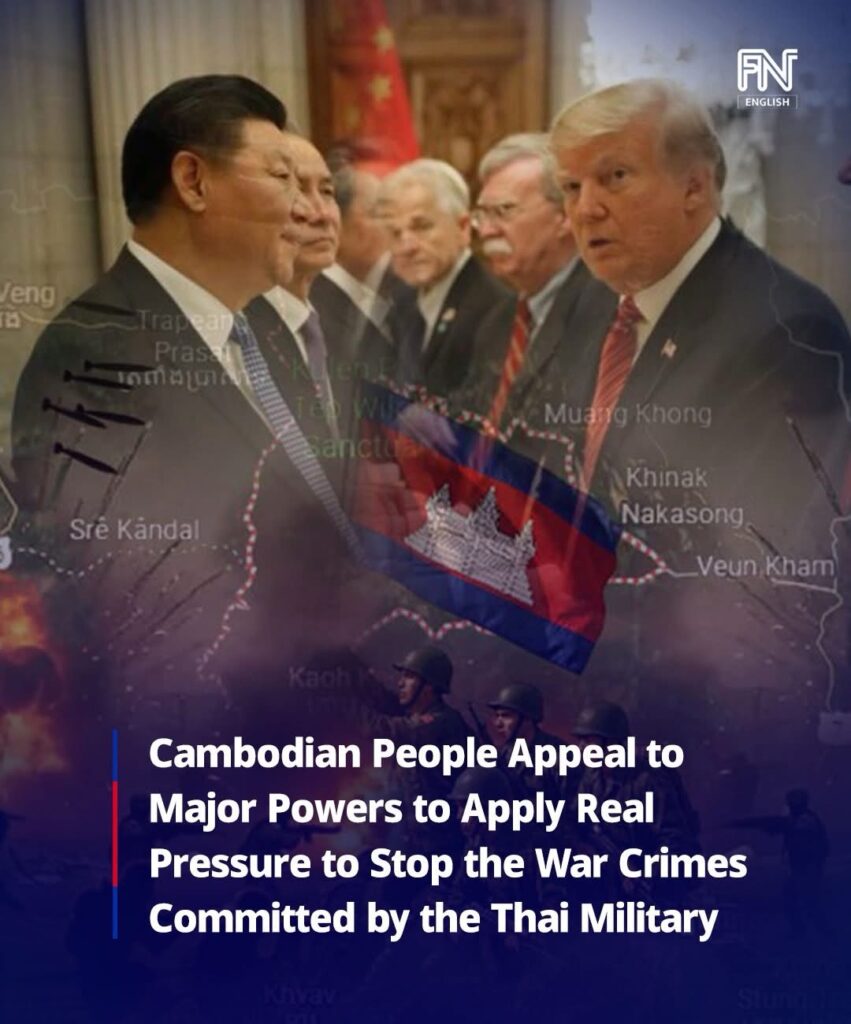
(Phnom Penh): Every day, even when the sound of gunfire along the border briefly falls silent, fear never does.
Along the Cambodia–Thailand border, Cambodian civilians continue to lose their lives and suffer injuries. The number of displaced families fleeing their villages keeps rising. Homes and public buildings have collapsed; others have been burned to the ground by artillery fire and aerial bombardment carried out by Thai fighter jets, including F-16s and Gripen aircraft. Thai troops, supported by tanks and armored vehicles, have advanced into Cambodian villages, firing indiscriminately. Security camera footage has shown armed Thai soldiers entering civilian homes, and in some cases stealing motorcycles abandoned by fleeing residents—riding away with weapons in hand, without the slightest sense of shame for these acts of looting.
While the ASEAN Foreign Ministers’ Meeting in Malaysia on December 22 failed to produce a solution to this grave crisis, Donald Trump, President of the United States, publicly reaffirmed his confidence that Washington has the ability and leverage to bring the war to an end.
Donald Trump’s Statement:
“And Thailand is starting to shape up. They started with Cambodia, they started up again, but I know, Marco, we are in pretty good shape to have that stopped.”
This statement was made in the United States on December 22, at a time when ASEAN mechanisms clearly lacked the power to apply meaningful pressure on Thailand to halt the fighting.
When President Trump told Marco Rubio that the United States is “in a good position to stop this war,” it raised a critical question for the international community:
Will the world continue to look away from Thailand’s evasive behavior and repeated violations, or will it finally apply real pressure to end a war that inflicts daily suffering on innocent civilians?
For Cambodia, this question cannot be delayed any longer. Thailand’s attacks—including the use of F-16 fighter jets—have caused severe loss of life and devastating humanitarian damage. Statements of condemnation and ceasefire agreements that exist only on paper have repeatedly failed to compel Thailand to comply.
Why Trump’s Words Matter for Cambodia
President Trump’s remarks are not merely diplomatic rhetoric. They signal power and leverage, not mediation alone. The message is clear: only real and sufficient pressure can force Thailand to change its behavior.
In Trump’s political worldview, wars do not end because of polite dialogue or symbolic agreements. They end when the cost of continuing the war becomes unbearable. His statement underscores that Thailand’s aggression cannot be stopped by words alone—nor by ceasefire documents without enforcement—but only when continued warfare carries consequences Thailand cannot afford.
For Cambodia, this clarification is crucial. It reinforces a painful truth long evident on the ground:
Condemnation without action cannot stop bombs. Appeals without pressure cannot protect civilians.
Cambodian people therefore interpret Trump’s remarks as a possible opening toward real action, including the preparation of serious sanctions, should Thailand persist in its aggression.
Cambodia Urgently Needs Peace as Lives Are Lost Every Day
The Cambodia–Thailand border conflict is not an abstract dispute or a war of political rhetoric. It is measured in blood and real human lives. Innocent civilians are killed daily. Others are injured, displaced, and forced to abandon their homes. Schools are closed. Pagodas are destroyed. Villages are reduced to rubble by bombing and indiscriminate shelling carried out by Thai forces that have violated Cambodian sovereignty and international law.
Cambodia did not choose war. The country has already endured immense suffering from past conflicts. Yet today, Cambodian civilians are once again forced to live under a modern war driven by heavy weapons and air power, launched by a neighboring country fueled by distorted historical narratives and territorial ambition.
This is a dispute that should be resolved through international law, not by military force.
Cambodia appeals to the world to open its eyes—and its conscience.
Cambodia does not want war to return to the lives of its people.
Cambodia does not want children to hear bombs instead of classroom lessons.
Cambodia does not want families to flee their homes instead of living normal lives.
And Cambodia does not want the fragile national reconstruction achieved after years of civil war to be destroyed once again by reckless violence.
The Role of China and the International Community
As war continues to devastate civilian life along the Cambodia–Thailand border, China, the European Union, and Cambodia’s regional and international partners have expressed deep concern for peace and stability. Among them, the People’s Republic of China has demonstrated a particularly active and responsible role.
China’s position has been clearly articulated by Foreign Minister Wang Yi, who emphasized that China—while a close friend of Cambodia—has acted as a neutral facilitator, working to promote an immediate ceasefire, encourage peaceful dialogue, and guide the crisis back toward a solution grounded in international law.
Cambodia has strongly welcomed China’s shuttle diplomacy, which seeks to reduce tensions, restore trust, and create enforceable conditions for a genuine ceasefire on the ground. These efforts underscore a fundamental truth: regional peace is a shared responsibility, and it requires concrete action, not mere statements.
In this spirit, Cambodia urgently calls on:
- ASEAN
- China
- The European Union
- And all international partners
to act together by: - Ending violence against Cambodian civilians
- Supporting a verifiable and enforceable ceasefire
- Pressuring the aggressor to respect international law rather than military force
- Restoring peace, safety, and stability so Cambodians can return to normal life
Cambodia believes that unified international action will be decisive in ending the war, stopping civilian suffering, and restoring peace with dignity and justice.
Conclusion
President Donald Trump’s words have opened a door.
The question now is not whether the war can be stopped, but whether the world is willing to act—or continue watching injustice unfold as Thailand destroys peace and hope in Cambodia.
Cambodia does not seek revenge.
Cambodia does not seek escalation.
Cambodia seeks real peace—peace backed by action, accountability, and respect for international law.
If real pressure, including sanctions, is the only way to stop the war and save lives, then the time to act is not tomorrow. It is now.
Every human life matters. And history will judge the world not by what it said—but by what it did when Cambodia and its innocent people most desperately needed help.