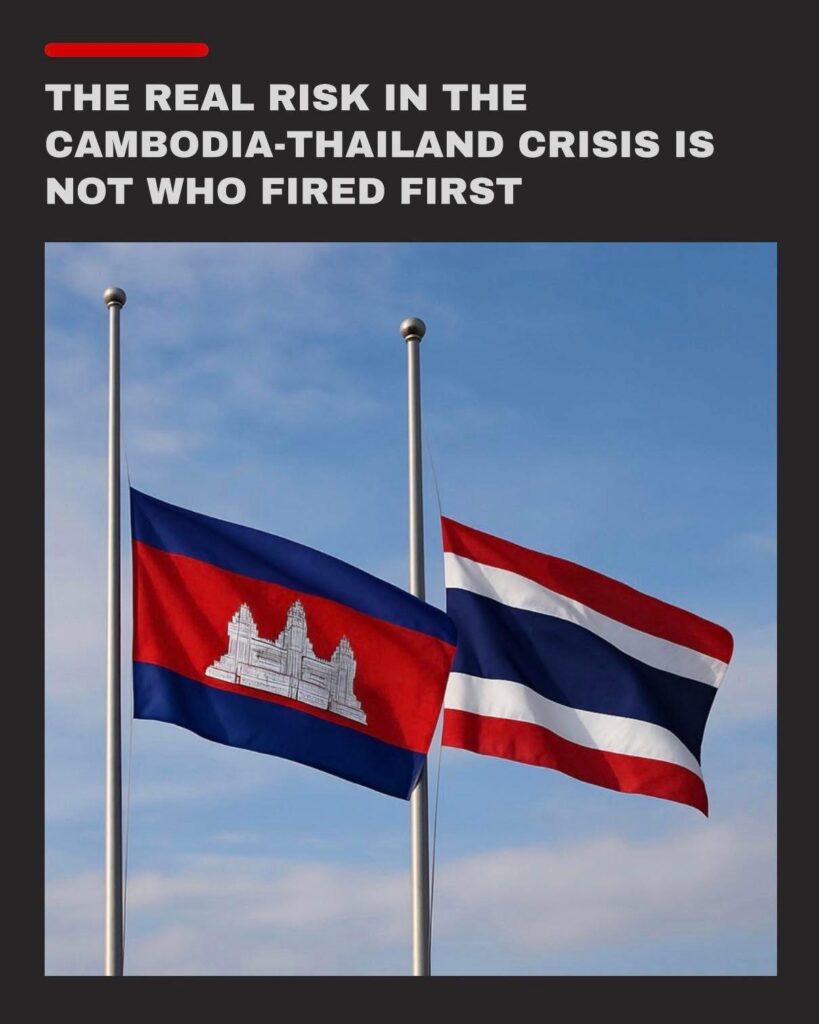
When fighting resumed along the Cambodia-Thailand border in early December, the public debate quickly fell into a familiar pattern. Who fired first. Which side provoked whom. Those questions dominate headlines and official statements. They are also the least useful place to focus if the aim is to prevent a wider and more durable conflict.
After spending the past days reviewing public statements, international reporting, and official communications, one conclusion stands out. The most serious risk in this crisis does not lie in the disputed trigger. It lies in the direction taken once violence was already under way.
This is not a legal argument. It is a practical one.
What we know and what we do not
There is no serious dispute that armed hostilities occurred on 7 and 8 December. Reuters, the BBC, and the Associated Press all reported exchanges of artillery and rocket fire along multiple stretches of the border, followed by Thailand’s use of air power. Thailand confirmed that it launched airstrikes using F sixteen fighter aircraft into Cambodian territory on December 8. Cambodia denied initiating the fighting. Independent reporting consistently noted that both sides accused each other of starting the clashes.
In short, the sequence of initiation remains unclear. No UN body, third party observer, or independent investigation has yet established who fired first.
What is clearer is the scale of what followed. Thailand evacuated more than four hundred thousand civilians from border provinces. Reuters reported shelling near a hospital in Surin province that forced the evacuation of patients and medical staff. These are not the markers of a minor frontier incident. They are signs of a serious security breakdown.
Why the trigger is not the decisive issue
In situations like this, international norms do not turn solely on who started the shooting. They also turn on how states respond once force is in play.
Here, Thailand’s own public language matters. According to a Reuters report on December 8, quoting senior Thai military officials, the objective of the operations was described as to cripple Cambodia’s military capability in order to neutralise the threat for a long time to come. This was presented as an explanation of purpose, not a retrospective interpretation.
That formulation deserves attention.
Suppressing active fire to protect territory and civilians is one thing. It implies responses tightly linked to the source of the threat, such as counter battery fire, limited strikes against active launch positions, or short duration operations designed to stop attacks already under way. Framing military action as the degradation of another state’s broader military capability points to a different logic altogether, one concerned with shaping the balance beyond the immediate crisis.
This distinction explains why concern has grown quietly among regional diplomats, ASEAN interlocutors, and officials in capitals that have invested years in stabilisation mechanisms along this border, even as public statements remain cautious.
The argument Thailand would make and where the line still lies
Thai officials could reasonably argue that they faced not sporadic fire but the risk of further escalation, that limited responses might invite additional rocket attacks, and that degrading launch capability decisively was the safest way to protect civilians. That assessment may have been sincerely held.
Even if that were the case, however, a further distinction matters. Suppressing launch capability directly tied to ongoing attacks is not the same as degrading a neighbour’s military capacity more broadly. The former remains anchored in immediate defence. The latter moves toward a preemptive or strategic posture.
If Thailand possessed intelligence indicating an imminent, large scale offensive by Cambodian forces, that context would materially alter how its response should be assessed. Intelligence of that nature is rarely made public during an active crisis. But in the absence of such evidence being disclosed, expansive public framing of military objectives inevitably raises concern that the response was designed not only to stop fire today, but to alter conditions tomorrow.
That is the moment where defence risks becoming escalation.
Cambodia’s role, credibility, and why it does not settle the question
Cambodia’s denial of responsibility should not be treated as dispositive. The border region has seen incidents initiated by both sides over the past two decades, including during the Preah Vihear confrontations between 2008 and 2011. Historical grievance and mutual suspicion are part of the landscape.
But proportionality does not turn on historical narratives. It turns on current threat and current response. Even where a neighbour has a record of provocation, restraint remains the stabilising principle once force is engaged. Past behaviour may explain threat perception. It does not, on its own, justify open ended military objectives in the present.
Why proportionality matters in Southeast Asia
Proportionality is often misunderstood as a technical legal concept. In practice, it functions as a stabilising norm. It reflects a shared expectation that force used for protection should not slide into force used for punishment or strategic demonstration.
This matters particularly in Southeast Asia, where border disputes have a long memory. The clashes around Preah Vihear between 2008 and 2011 offer a clear precedent. What began as limited confrontations escalated rapidly, drew in heavy weaponry, and ultimately required international adjudication to restore a fragile calm. The region learned then how quickly disputed ground can become a diplomatic liability.
ASEAN’s preference for restraint, dialogue, and de escalation was shaped by those experiences. ASEAN has not issued a collective response as of this writing, which may reflect diplomatic caution during active hostilities, or the difficulty of forging consensus in contested bilateral disputes where member states maintain varying relationships with both parties.
When a crisis moves rapidly from contested skirmishes to high intensity air operations framed in broad terms, it tests not only bilateral relations but the credibility of those regional norms.
Other governments in the region are watching closely, not to assign blame, but to understand what kinds of responses are treated as acceptable once force is invoked. Precedents set in moments like this rarely remain local.
A case for restraint, not recrimination
This is not an argument for passivity in the face of threat, nor a denial of Thailand’s right to security. It is a reminder that how a state defines and limits its response can be as consequential as the response itself.
The UN Secretary General’s statement on December 8 was carefully calibrated. It expressed concern about renewed clashes, called for restraint, and avoided attributing responsibility. That neutrality reflects a basic truth. Escalation is far easier to start than to stop.
If there is a lesson from the past week, it is that the debate must move beyond contested origins and focus instead on preventing further expansion of the conflict. That requires restraint not only in action, but in ambition.
Borders can be defended without being destabilised. But when the language of defence begins to resemble the language of long term military degradation, the risk is no longer who wins the argument. It is how hard the war becomes to end.
References
Reuters, reporting on Thailand–Cambodia border clashes and airstrikes, 8 to 10 December 2025
BBC News, coverage of escalation and civilian evacuation, 8 to 9 December 2025
Associated Press, reporting on border fighting and displacement, 9 to 11 December 2025
Letter from the Permanent Mission of Thailand to the UN Security Council, 9 December 2025
Statement by the UN Secretary General, 8 December 2025