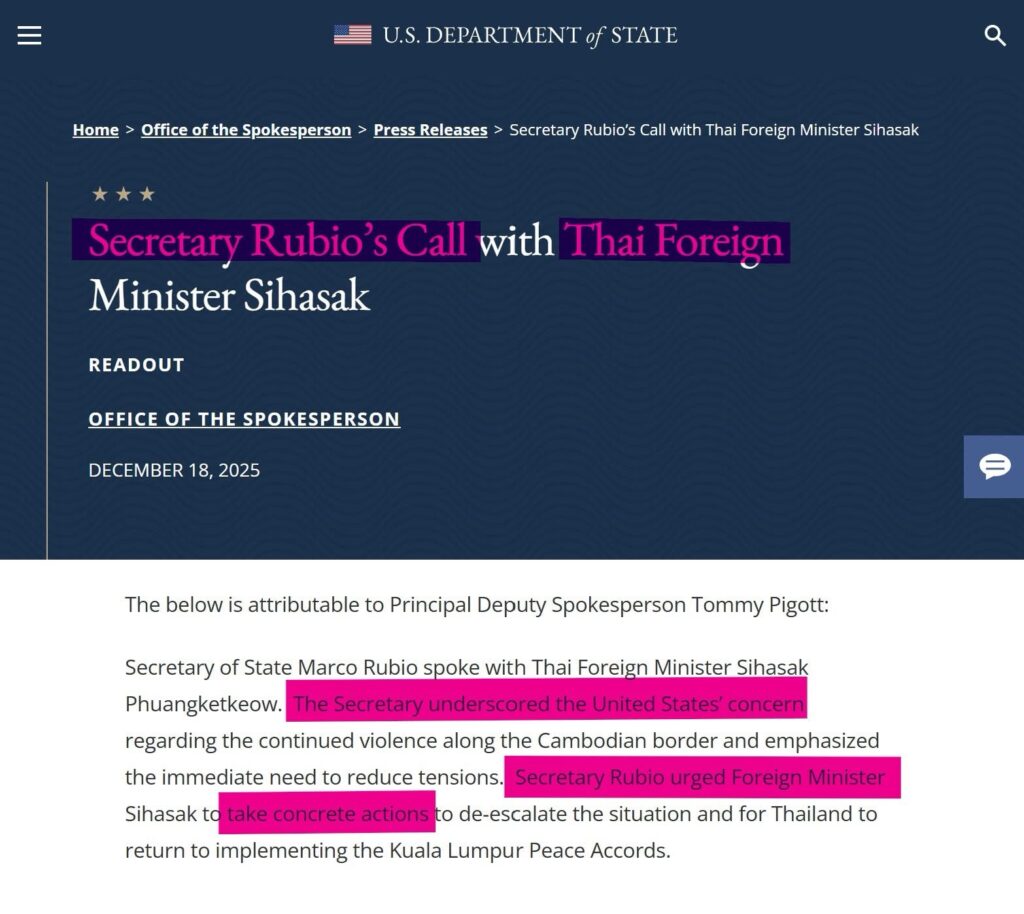
On December 18, the United States disclosed a call between Secretary of State Marco Rubio and Thailand’s Foreign Minister Sihasak Phuangketkeow.
The wording matters.
Washington said it was concerned about continued violence along the Cambodian border, urged Thailand to take “concrete actions” to de-escalate, and explicitly called on Thailand to return to implementing the Kuala Lumpur Peace Accords.
That phrasing is not neutral. It is not symmetrical. And it is not accidental.
“Return to implementing” is compliance language. It assumes a signed pathway exists and that implementation has stalled or drifted. It directs action toward one side in a specific procedural framework rather than offering a general appeal for calm.
At the same time, Thai domestic messaging tells a different story.
Thai official statements and local media coverage present the call as routine coordination. The emphasis is placed on Thailand “reaffirming its position,” attending the upcoming ASEAN Foreign Ministers’ Meeting in Kuala Lumpur, and acting responsibly. The word pressure is rejected. The idea that Thailand needs to “return” to anything is quietly disputed, with officials asserting that Thailand never departed from the Kuala Lumpur framework in the first place.
This gap between readouts is the signal.
Internationally, Washington is anchoring the crisis back to a witnessed agreement and asking for visible de-escalation steps. Domestically, Thailand is reframing the same exchange as confirmation of its legitimacy and reasonableness, while shifting the burden of compliance elsewhere.
Neither side is escalating rhetorically. Both are positioning.
What the US readout also does not do is important. It does not repeat Thailand’s accusations. It does not endorse any battlefield narrative. It does not invoke self-defence arguments. Instead, it points back to process, implementation, and restraint.
That is how directional pressure works in diplomacy: not through condemnation, but through selective language and timing.
And the timing matters.
This call comes days before the ASEAN meeting in Kuala Lumpur, where de-escalation mechanics, observers, and verification will be discussed. By invoking the Kuala Lumpur Peace Accords now, Washington is shaping the frame before the room convenes, not after decisions are locked in.
For Cambodia, the strategic response is not celebration or claim-making.
The durable move is alignment with the same standard implied in the US language: visible de-escalation, procedural compliance, and verification under ASEAN mechanisms. That is the lane that survives international scrutiny, regardless of narrative competition.
What happens next will not hinge on statements.
It will hinge on whether “return to implementation” becomes measurable behavior once the ASEAN process begins.
That is the pressure point to watch.
Midnight