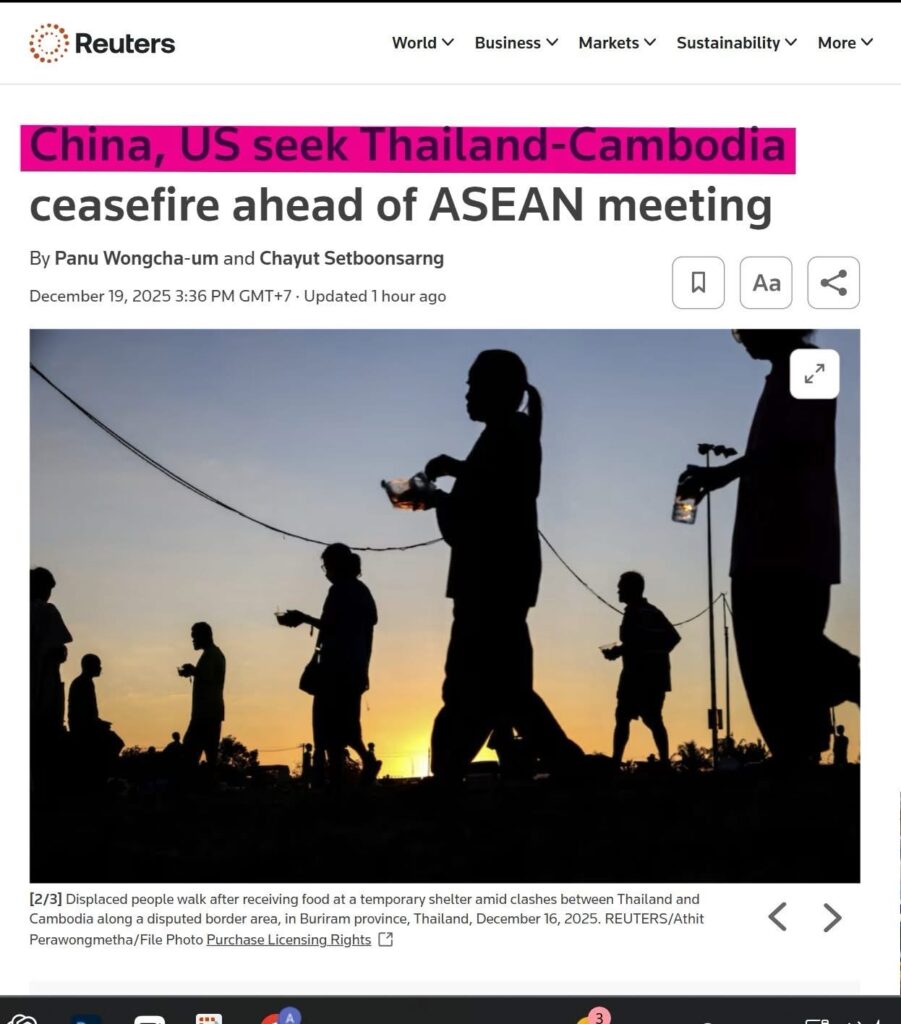
In the last 24 hours, the Cambodia–Thailand situation quietly moved into a new phase.
The fighting along the border is still real and still serious. But the decisive arena is no longer only the battlefield. It has shifted into legitimacy management.
When both the United States and China speak publicly at the same time urging restraint, this is not commentary. It signals that the conflict is now being treated as a regional stability risk, not just a bilateral dispute. From this point on, perception by third parties begins to matter as much as events on the ground.
This is why the upcoming ASEAN meeting in Kuala Lumpur carries weight. Not because it guarantees de-escalation, but because it becomes a reputational checkpoint. The question being shaped moves away from who fired last and toward who appears cooperative, who appears obstructive, and who sets conditions that delay de-escalation.
The mechanics are familiar. One side places preconditions on ending the fighting. The other is described as acting defensively. Allegations are referenced while verification mechanisms remain vague. Silence is noted. Engagement is highlighted. None of this happens by accident.
At this point, how events are framed begins to shape diplomatic space.
For Cambodia, this phase is not determined by volume of statements but by insistence on process. Verification matters. Sequencing matters. Independent monitoring matters. Allegations that carry escalation consequences require agreed mechanisms for examination, not quiet acceptance as assumed fact. In regional conflicts, legitimacy tends to accrue to those willing to accept transparent obligations that apply equally.
What increasingly defines this phase is structure rather than rhetoric: sequencing, mutual obligations, independent verification, monitoring arrangements, and timelines that bind all parties. Without these, calls for ceasefire remain political pressure rather than durable resolution.
This moment is less about choosing sides and more about understanding how stabilization efforts work. Often, they are designed to freeze escalation first, leaving deeper disputes unresolved.
Clarity at this stage reduces confusion later.
Midnight