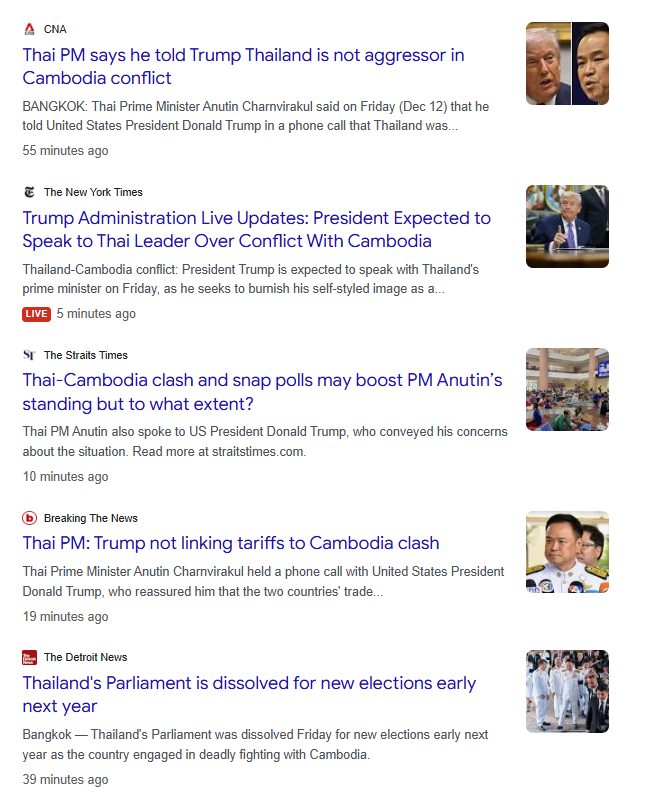
What most people are missing is that when Anutin tells Trump “Thailand is not the aggressor,” he is not trying to persuade Trump. He is speaking to the record. This is pre-litigation, not diplomacy. It is an attempt to manufacture future sentences that can later be cited: that the U.S. President was informed Thailand was not the aggressor, that Thailand communicated its defensive posture at the highest possible level. Reuters repeating this as attribution does not validate the claim, but it archives it. That is the point. This is documentation warfare. Whoever gets their narrative into high-level calls first tries to turn it into institutional memory.
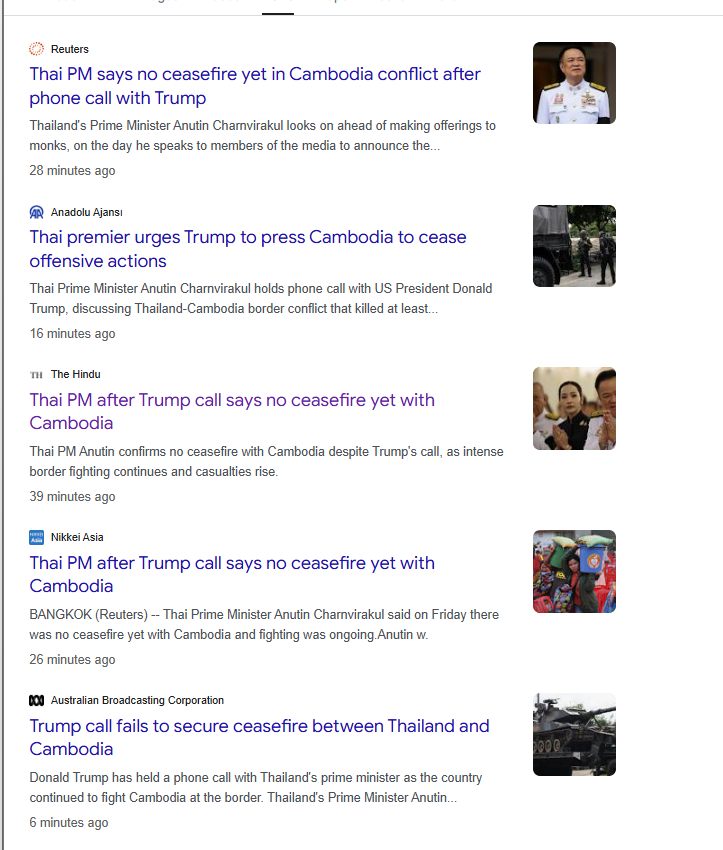
The same logic applies to the so-called ceasefire conditions. When he says Cambodia must withdraw troops, remove mines, and “stop everything first,” that is not ceasefire language. It is a maximal compliance demand. Functionally, it makes a ceasefire unattainable unless Cambodia concedes the entire frame. It allows Thailand to say “we want peace” while ensuring peace cannot occur on equal terms. And it sets Cambodia up to look like the spoiler if those terms are rejected. What looks reasonable on the surface is actually a classic move to keep military options open while sounding cooperative.
The tariffs line is the real signal most people are glossing over. Reuters noting that Trump did not raise tariffs sounds like a minor detail, but it isn’t. It tells elites that the U.S. did not bring a coercive tool to the table, that Thailand is not being cornered by Washington in this moment, and therefore that the conflict can continue without immediate economic penalty. At the same time, the phrasing acts as a placeholder. Saying tariffs were “not indicated” implies they were thinkable enough to mention at all. This is a shadow lever. Reuters is quietly telling professionals where pressure could go next, even while reporting that it did not go there in this call.
There is also a major omission embedded in the story: who actually controls escalation on Thailand’s side. Everyone talks as if Anutin is the single command node, but dissolution during active fighting plus continued clashes raises a deeper question. In caretaker mode, who can credibly commit Thailand to restraint? Does the civilian leader actually control the tempo of force, or is he narrating around it? Reuters cannot say this directly, but the structure of the story invites the reader to ask it. Quietly, this becomes a story about control of force inside Thailand, not only across the border.
The so-called “verification gap” is not a gap at all. Reuters saying it is unclear whether Trump spoke to Hun Manet is more than uncertainty. It is a diplomatic signal. If Cambodia is not spoken to, Cambodia cannot be made to “accept” anything. If Cambodia is spoken to later, it will look like a response to Thailand’s framing. Either way, sequencing shapes responsibility. “Unclear” is a soft way of saying the channel is uneven, and uneven channels produce uneven outcomes.
Once the election timeline is fused with the fighting, the frame shifts again. This is no longer just domestic politics. It is risk packaging for the world. International audiences stop asking who started it and start asking who benefits from prolongation and who cannot afford compromise. Conflict becomes part of an electoral environment, and electoral environments reward nationalism. Once this frame hardens, every Thai statement is read as campaign logic, not purely security logic.
Strip away Trump’s personality and look at the U.S. institutionally, and the contrast is stark. Trump’s call is headline diplomacy. The U.S. Embassy alert is the real U.S. It is colder, cautious, documentation-centered, and not emotionally aligned with Thai talking points. “Avoid the border,” “volatile,” “reports of airstrikes.” Washington is splitting into two layers: Trump as the face of personal mediation, and institutions as record-keepers and risk managers. When those diverge, institutions usually win.
The global media cascade itself also matters. Because Reuters is the spine, Thailand gains a strategic advantage: a global distribution channel for its on-record claims, even when they are carefully attributed. Attribution does not stop spread. It still broadcasts the framing internationally at low cost, without needing universal agreement. In narrative war, distribution is half the battle.
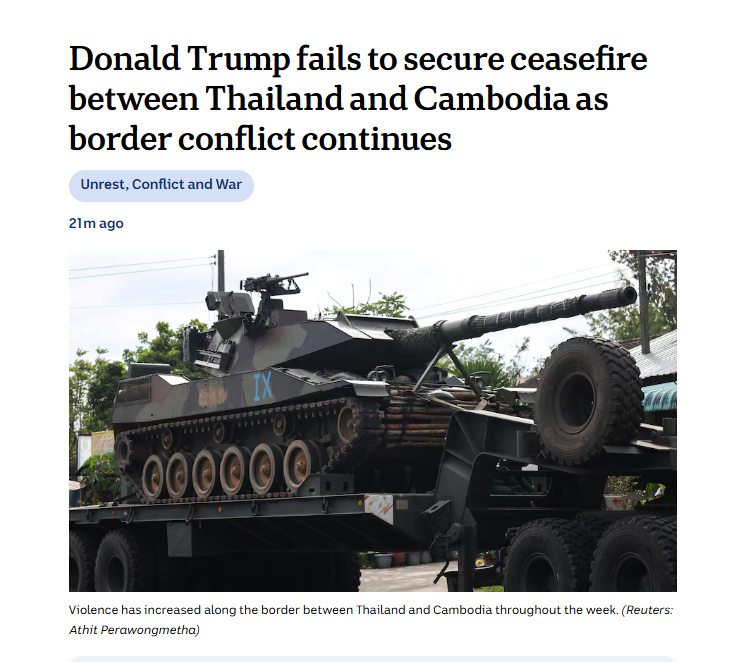
The quiet danger in all of this is where the story’s center of gravity moves. Once the dominant frame becomes “Trump tried, no ceasefire yet,” the moral focus shifts from territorial violation to failed mediation. From legality to process. From responsibility to negotiations ongoing. That is extremely convenient for any side that wants the world focused on diplomacy mechanics rather than accountability.
Midnight