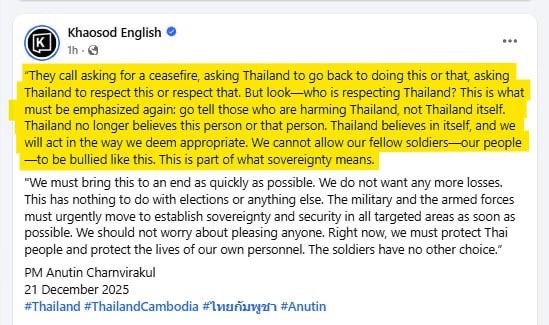
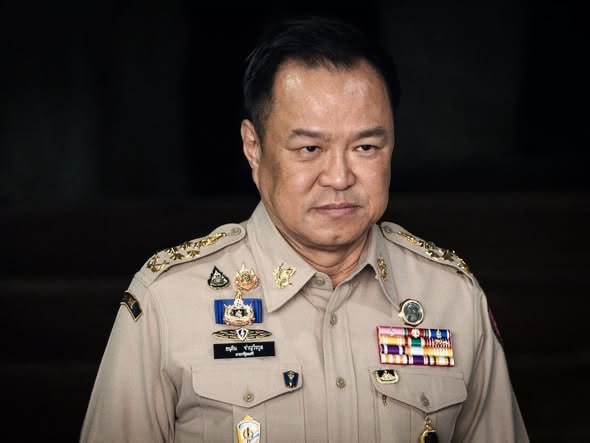
When Prime Minister Anutin Charnvirakul says Thailand no longer believes “this person or that person,” and will act only according to what it deems appropriate, he is not speaking emotionally. He is signaling posture.
This is not a battlefield message. It is a positioning message.
The emphasis on sovereignty here is important. It is framed not as law, treaty, or process, but as discretion and autonomy. In other words, Thailand is asserting the right to decide speed, scale, and direction without external pacing or verification.
The repeated insistence that this has “nothing to do with elections” is also telling. Leaders usually deny political linkage only when legitimacy is expected to be questioned. That does not imply bad faith, but it does reveal sensitivity to scrutiny.
What stands out most is the compression of time. “End this as quickly as possible,” paired with “the soldiers have no other choice,” closes the space for prolonged mediation or layered de-escalation. Urgency becomes authorization.
Internationally, this kind of language is not read as anger. It is read as commitment. It signals that internal debate has narrowed, civilian and military leadership are aligned, and external pressure is being downgraded from guidance to noise.
This posture can be effective in the short term. But it is also brittle. When verification is sidelined and process is paused, outcomes matter more than intentions. Any miscalculation carries heavier consequence.
None of this assigns blame. It simply marks a phase.
Thailand is no longer arguing about narratives.
It is asserting control over timing.
That is the moment we are in.
Midnight